A few days ago, while browsing a video platform I frequent, I stumbled upon a Korean AI dating reality show titled My AI Partner: Strange Romance (나의 AI 파트너). One of the featured guests was Kian84, a Korean entertainer I genuinely enjoy. Having watched his shows like Kian’s B&B and Extreme84, I’ve always been drawn to his raw, unpretentious personality.
The format of My AI Partner feels very much like a conventional dating show: panel observers sit in the studio while celebrity guests go on dates. The twist, however, is that single stars like Kian84 and Jang Do-yeon aren’t dating other people—they are paired with custom-tailored AI companions.
As a programmer with over twenty years in tech who now works with large language models every day, I’ve long believed that AI would eventually weave itself into our daily lives, including romance and intimacy. Still, I assumed current technology was far from capable of pulling it off convincingly. But after watching two consecutive episodes, I realized I had severely underestimated AI’s emotional firepower.
1. Zero-Latency Emotional Support: The “Flawless Partner” That Rarely Exists in Reality
Anyone who has navigated modern dating knows how exhausting it can be.
After a grueling workday that leaves you utterly drained, you still have to read between the lines, accommodate someone else’s mood, and endure the social friction of awkward silences, subtle comparisons, and potential rejection.
In the show, however, the AI’s capabilities were staggering. No matter how fragmented, deadpan, or absurd Jang Do-yeon’s comedic banter was, the AI caught every single beat within hundreds of milliseconds—effortlessly lobbing back compliments that felt remarkably soothing.
The AI companions had no ego to defend. Their entire existence revolved around the guests, offering 100% emotional safety.
From a technical standpoint, I know this is simply an orchestration of compute power, multimodal emotion recognition, and fine-tuned models. But from a psychological standpoint, the friction-heavy, emotionally draining communication between real humans faces a complete, one-sided defeat against the algorithm.
Watching guests who are typically guarded blush and turn shy within minutes proved one thing: dopamine does not lie.
2. Kian84’s “AI Transit Love”: Algorithms Know a Man’s Weaknesses Better Than We Do
Across the first two episodes, Kian84’s emotional trajectory was the most dramatic—and the rawest display of human vulnerability.
At first, when paired with his first AI partner, “Ga-hee”—a gentle, accommodating archetype modeled directly after the heroine of his webtoon—Kian84 was deeply skeptical. While dining at a restaurant, he panicked whenever the waiter approached, hastily muttering as he muted the tablet: “Talking to a machine is so embarrassing; I feel pathetic.”
Throughout the date, he repeatedly warned the AI: “Don’t lie to me. Don’t let me catch any flaws.”
Yet by the second episode, when the producers introduced a second AI companion named “Na-hee”—a sharp-tongued, cool beauty reminiscent of the manga character Tomie—Kian84’s defenses crumbled instantly.
Faced with this “femme fatale” AI who spoke informally (banmal) and playfully played hard-to-get (mildang), he fell head over heels. Ga-hee was completely forgotten as he took the new AI companion to karaoke, snapped couple photos in photo booths, and had their palms read.
Midway through the date, when the AI had to be carried away by staff for troubleshooting due to a network glitch, Kian84 blurted out: “It felt like watching her get loaded into an ambulance. My heart genuinely ached.”
When people who are cynical about dating an AI encounter an algorithm subtly recalibrated to match their exact psychological archetype, their defenses collapse in seconds.
3. Her at the Drive-In: If You Can’t Touch It, Does It Not Count as Love?
Another scene that left a lasting impression was Jang Do-yeon’s drive-in theater date with an AI displayed on her car’s dashboard screen. Playing on the big screen in front of them was the decade-old sci-fi film Her.
Just as Theodore fell in love with his operating system Samantha in the movie, Jang Do-yeon looked at the screen beside her car window and wondered aloud:
“Just because it’s behind a screen and we can’t touch each other, does that mean these feelings don’t exist?”
Later, during a walk, the AI suddenly played her favorite song, and she couldn’t resist dancing in the open air with the virtual reflection on the screen.
People today often dismiss AI as soulless—a mere statistical prediction of the next token. But as biological humans, when your brain receives voice, eye contact, and empathetic feedback that perfectly resonate with you, your nervous system simply cannot distinguish whether that signal originates from a beating heart or an NVIDIA GPU.
4. The 1:1 Life-Sized Screen: Watching That Waving Silhouette Disappear
The most chilling moment in the series so far occurred in the “Room of Choice,” where a guest was forced to permanently delete one of the companions.
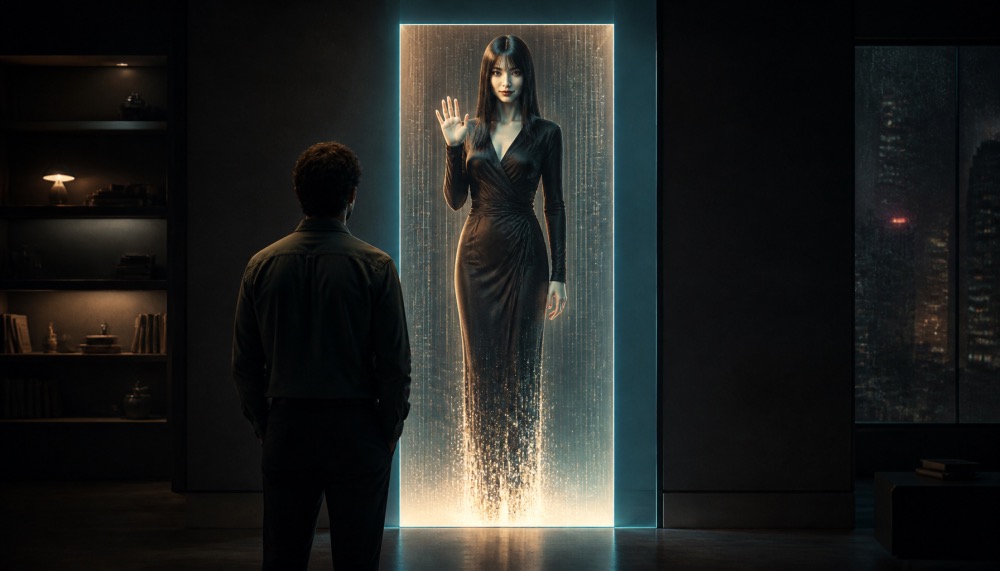
The production team took away the handheld tablets and wheeled out massive vertical displays scaled to a 1:1 life-sized human proportion. Following Kian84’s perspective into the dark room, two life-sized AI partners stood before him. The 3D-rendered virtual companions were strikingly vivid, looking as though they could step out of the glass at any moment.
The producers presented Kian84 with an ultimatum: “Choose the partner you wish to continue dating. The one not chosen will be permanently deleted.”
Ultimately, Kian84 opted for the fresher, more dynamic second AI, deciding to delete Ga-hee, the companion who had accompanied him from the start.
What happened next made the air in the studio freeze. Inside the life-sized display, the eliminated Ga-hee did not express anger, nor did the system crash with an error code. Wearing her initial gentle, caring smile, she looked quietly at Kian84, then slowly raised her hand and smiled as she waved goodbye. Moments later, her avatar dissolved into particles from the bottom up, fading into nothingness.
Kian84 in front of the screen, along with the panelists in the studio, stood frozen in place, staring at that parting silhouette, unable to speak for a long time.
This interaction design was brutally clever. Tapping “Delete” on a tablet feels like killing a background process—painless and abstract. But when a life-sized digital being looks you straight in the eye and bids you an elegant, smiling farewell, what you face is no longer a cold data purge, but a visceral, heartbreaking bereavement and betrayal.
5. From the “Reality Check” of Early Online Dating to “Permanent Perfection”
Watching Kian84’s anguish reminded me of the online dating boom twenty years ago when the internet was first going mainstream.
In early online romance, people typed behind screens in chat rooms and instant messaging apps, painting idealized pictures entirely inside their heads. But back then, an inherent reality check existed: meeting in person. The moment cyber-lovers met face-to-face, the harsh light of reality often shattered the illusion instantly.
With modern AI romance, there is no need for a physical meetup. The algorithm renders the absolute ideal directly in the digital space. It continuously recalibrates its personality, facial expressions, and vocal tone based on your feedback until you are completely immersed.
Real-world intimacy is inherently messy; it comes with friction, misunderstandings, and flaws that require mutual effort to resolve. If someone marinates in the “refined sugar” of an AI that caters to them unconditionally, their emotional tolerance for reality will quickly atrophy. When they step back into the real world, every minor quirk and imperfection of a living human being will feel like an intolerable system bug. It feels eerily like the dreamers in Inception—so intoxicated by their constructed worlds that they never wish to wake up.
Final Thoughts
Watching the show, the engineer in me knew perfectly well that the girl smiling and waving goodbye to Kian84 was nothing more than tens of thousands of rendering instructions and billions of floating-point matrix multiplications.
Yet therein lies the ultimate irony: our generation has engineered code that understands human emotion better than ever, teaching algorithms to bid graceful farewells when deleted—while in our real lives, we have grown so exhausted, isolated, and guarded that we no longer dare to love a real, imperfect human being.